

Are you looking to purchase a home in a rural area but struggling with financing options? You’re not alone. Many individuals and families face challenges in securing affordable loans for homes outside urban centers.
USDA Rural Home Loans offer a viable solution, providing affordable financing with favorable terms for eligible borrowers. These loans are designed to support individuals looking to purchase or improve homes in designated rural areas.
With rural development loan requirements that are more lenient compared to traditional loan options, these programs aim to boost rural development by making homeownership more accessible.
Key Takeaways
Table of Contents
- USDA Rural Home Loans offer affordable financing options.
- Eligible borrowers can enjoy favorable loan terms.
- These loans support rural development by promoting homeownership.
- Rural development loan requirements are more lenient.
- These programs are designed for homes in designated rural areas.
Understanding USDA Rural Home Loans
Understanding the intricacies of USDA Rural Home Loans is crucial for potential homebuyers seeking to take advantage of these beneficial programs. The USDA offers various loan options tailored to assist low-to-moderate-income individuals in purchasing homes in rural areas.
Types of USDA Loan Programs
The USDA provides several loan programs, including the USDA Direct Loan Program and the USDA Guaranteed Loan Program. The USDA Direct Loan Program is designed for low-income borrowers, offering subsidized interest rates and mortgage payments. The USDA Guaranteed Loan Program, on the other hand, guarantees loans made by approved lenders, providing more lenient credit score requirements.
History and Purpose of the USDA Loan Program
The USDA Loan Program was established to promote rural development by making homeownership more accessible. The program aims to improve the quality of life in rural areas by providing affordable housing financing options. To be eligible, borrowers must meet specific income limits and credit score requirements, among other criteria.
| Loan Program | Key Features | Eligibility Criteria |
|---|---|---|
| USDA Direct Loan Program | Subsidized interest rates, mortgage payments | Low-income borrowers, rural areas |
| USDA Guaranteed Loan Program | Guarantees loans from approved lenders, lenient credit scores | Low-to-moderate-income borrowers, rural areas |
Key Benefits of USDA Rural Home Loans
The USDA Rural Home Loan program is designed to make homeownership more accessible, offering several significant benefits. One of the most compelling advantages is the ability to secure a home loan without the burden of a down payment.
No Down Payment Requirement
Unlike many other mortgage options, USDA Rural Home Loans do not require a down payment. This feature makes it easier for homebuyers to purchase a home without having to save for a significant down payment. This can be a game-changer for many families, allowing them to allocate their savings towards other important expenses.
Competitive Interest Rates
USDA Rural Home Loans also offer competitive interest rates, which can result in lower monthly mortgage payments. When comparing loan options, it’s essential to consider the interest rate, as it can significantly impact the total cost of the loan over its lifetime. Working with approved USDA loan lenders can help borrowers secure the best possible rates.
Reduced Mortgage Insurance Costs
Another benefit of USDA Rural Home Loans is reduced mortgage insurance costs compared to other low-down-payment loan options. While there are still insurance premiums associated with USDA loans, they are generally lower than those of other mortgage insurance programs. This reduction in costs can make a significant difference in the overall affordability of the loan.
To illustrate the benefits, consider the following comparison table:
| Loan Feature | USDA Rural Home Loan | Conventional Loan |
|---|---|---|
| Down Payment Requirement | No down payment | Typically 20% down |
| Interest Rates | Competitive rates | Varies based on market |
| Mortgage Insurance | Reduced costs | Higher premiums for low down payments |
When considering usda loan property requirements, it’s crucial to understand that these loans are designed for properties in rural areas, as defined by the USDA. Working with knowledgeable USDA loan lenders can help borrowers navigate these requirements and find the right property.
USDA Loan Eligibility Requirements
Eligibility for USDA Loans is determined by several key factors, including income limits, credit score requirements, and debt-to-income ratio guidelines. Understanding these requirements is essential for potential homebuyers to determine their eligibility.
Income Limits and Calculations
The USDA sets income limits for loan eligibility, which vary by location and household size. Generally, the income limit is set at or below 115% of the median income for the area. For example, in areas with a lower cost of living, the income limits may be lower compared to areas with a higher cost of living.
Income calculations take into account the gross income of all household members, including wages, salaries, and other forms of income.
Credit Score Requirements
While the USDA doesn’t have a minimum credit score requirement, lenders often set their own standards. Typically, a credit score of 640 or higher is considered acceptable for USDA Loans. However, some lenders may consider applicants with lower credit scores on a case-by-case basis.
Debt-to-Income Ratio Guidelines
The debt-to-income (DTI) ratio is another critical factor in determining eligibility. The USDA allows a DTI ratio of up to 41%, although some lenders may have more stringent requirements. The DTI ratio is calculated by dividing the total monthly debt payments by the gross income.
To increase their chances of approval, applicants should review these eligibility requirements carefully and prepare their financial documents accordingly. Understanding how to apply for USDA Loan programs can also help streamline the application process.
Property Requirements for USDA Loans
To qualify for a USDA Loan, properties must adhere to certain guidelines. The USDA has specific requirements regarding the location, condition, and type of property that can be financed through their loan programs.
Rural Area Definitions
The USDA defines “rural areas” as regions that are outside of metropolitan areas and cities with a population of 35,000 or more. The USDA’s Rural Development program provides maps and online tools to help determine if a property is located in a qualifying rural area.
Property Condition Standards
Properties financed through USDA Loans must meet minimum property standards, which include being in good condition, having a safe and sanitary environment, and being free from hazards. The property must also be intended for residential use.
Eligible Property Types
USDA Loans can be used to purchase various types of properties, including single-family homes, condominiums, and new constructions. The following table summarizes the eligible property types and their characteristics:
| Property Type | Description |
|---|---|
| Single-Family Homes | Detached homes designed for one family |
| Condominiums | Units within a complex that meet USDA guidelines |
| New Constructions | Newly built homes that meet USDA property standards |
Understanding these property requirements is essential for borrowers to ensure that their desired property qualifies for a USDA Loan. By meeting these guidelines, borrowers can take advantage of the affordable financing options offered by the USDA.
How to Apply for USDA Rural Home Loans
Navigating the USDA Rural Home Loan application process can be simplified by understanding the requirements. The process involves several key steps that, when followed correctly, can lead to a successful application.
Finding Approved USDA Loan Lenders
The first step in applying for a USDA Rural Home Loan is to find an approved lender. USDA loan lenders are financial institutions that have been approved by the USDA to originate and service USDA loans. You can find a list of approved lenders on the USDA’s official website or by contacting a local mortgage broker.
It’s essential to research and compare different lenders to find the one that best suits your needs. Consider factors such as interest rates, fees, and customer service.
Gathering Required Documentation
To apply for a USDA Rural Home Loan, you’ll need to gather various documents, including:
- Identification documents (e.g., driver’s license, passport)
- Income verification (e.g., pay stubs, W-2 forms)
- Employment history
- Credit reports
- Property information (e.g., property deed, appraisal report)
Submitting Your Application
Once you’ve gathered the necessary documents, you can submit your application to the lender. The lender will review your application and guide you through the pre-approval process.
Pre-Approval Process
During the pre-approval process, the lender will review your creditworthiness and financial situation to determine the loan amount you’re eligible for. This step is crucial in understanding your budget before house hunting.
Final Approval and Closing
After finding a property, the lender will conduct a final review of your application and the property’s eligibility. Once approved, you’ll proceed to closing, where you’ll sign the final documents and complete the purchase.
The following table summarizes the key steps and timelines involved in the USDA Rural Home Loan application process:
| Step | Description | Timeline |
|---|---|---|
| Pre-Approval | Lender reviews creditworthiness and financial situation | 1-3 days |
| Application Submission | Submit application with required documentation | 1-2 days |
| Final Approval | Lender conducts final review of application and property | 7-14 days |
| Closing | Sign final documents and complete purchase | 1 day |
By understanding the USDA loan application process, you can better navigate the requirements and increase your chances of a successful application. For more information on how to apply for USDA loan, you can visit the USDA’s official website or consult with an approved lender.
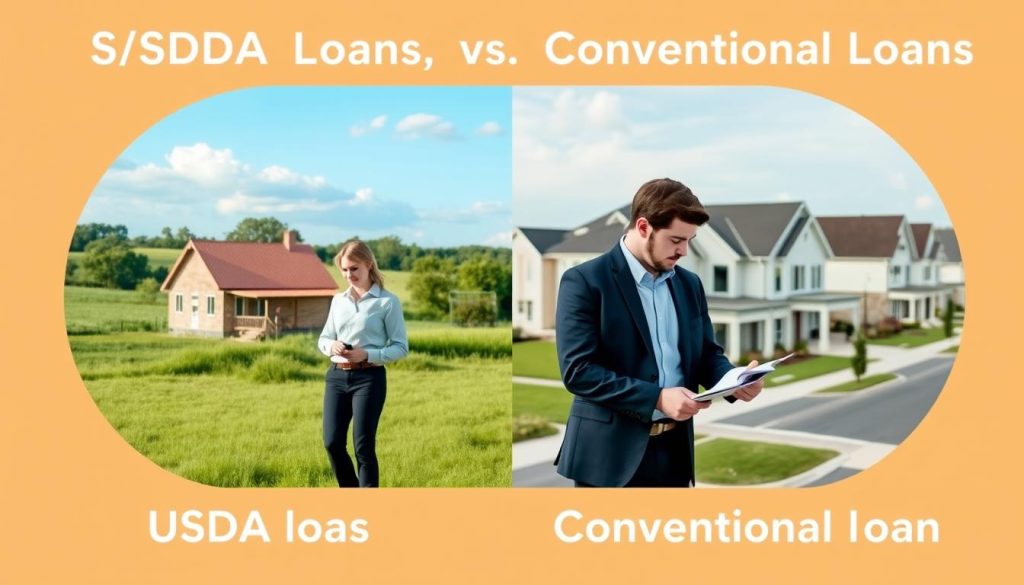
USDA Loans vs. Conventional Loans: Key Differences
USDA loans and conventional loans are two distinct financing options available to homebuyers, each with its own set of advantages and eligibility criteria. Understanding these differences is essential for prospective homeowners to make informed decisions.
Down Payment Comparison
One of the most significant differences between USDA loans and conventional loans is the down payment requirement. USDA loans do not require a down payment, making them an attractive option for those who may not have the funds for a down payment. In contrast, conventional loans typically require a down payment, which can range from 5% to 20% of the purchase price.
Interest Rate Differences
Interest rates for USDA loans and conventional loans can vary. USDA loans often offer competitive interest rates, and the lack of a down payment requirement can make them more appealing. Conventional loans, however, may offer more flexibility in terms of loan terms and interest rate options.
Mortgage Insurance Considerations
USDA loans require mortgage insurance, but the premiums are generally lower compared to conventional loans with less than 20% down payment. For conventional loans, private mortgage insurance (PMI) is typically required for down payments less than 20%.
Eligibility Restrictions
USDA loan eligibility is restricted to properties located in rural areas as defined by the USDA, and there are income limits that apply. Conventional loans have no such geographic or income restrictions, making them available to a broader range of borrowers.
| Loan Feature | USDA Loan | Conventional Loan |
|---|---|---|
| Down Payment | No down payment required | Down payment required (5%-20%) |
| Interest Rates | Competitive rates | Variable rates |
| Mortgage Insurance | Lower premiums | PMI required for less than 20% down |
| Eligibility | Rural areas, income limits | No geographic or income restrictions |
Overcoming Common USDA Loan Challenges
While USDA Loans offer numerous benefits, applicants often face several hurdles that need to be addressed. Understanding these challenges is crucial to navigating the application process successfully.
Addressing Income Limit Issues
One of the primary challenges is adhering to the income limits set by the USDA. These limits vary by area and are based on the median income for that region. To overcome this, applicants can review the current income limits for their area and plan accordingly. It’s essential to ensure that your income is within the allowable limits before applying.
Navigating Property Eligibility Concerns
Property eligibility is another significant challenge. The USDA has specific requirements regarding the location and condition of the property. Ensuring that the property is in a designated rural area and meets the USDA’s property condition standards is vital. Applicants can use the USDA’s online mapping tool to check if a property is eligible.
Dealing with Longer Processing Times
USDA Loans are known to have longer processing times compared to conventional loans. To mitigate this, applicants should submit their applications well in advance of their intended closing date. Working with an experienced lender can also help streamline the process.
| Challenge | Solution |
|---|---|
| Income Limit Issues | Review current income limits and plan accordingly |
| Property Eligibility Concerns | Use USDA’s online mapping tool to check property eligibility |
| Longer Processing Times | Submit applications well in advance and work with experienced lenders |
By understanding and addressing these common challenges, applicants can improve their chances of successfully securing a USDA Loan.
Conclusion
USDA Rural Home Loans offer an attractive financing solution for homebuyers in rural areas. With benefits like no down payment requirement and competitive interest rates, these loans provide an affordable alternative to conventional loans.
When comparing USDA Loans to conventional loans, key differences emerge. USDA Loans have more lenient credit score requirements and lower mortgage insurance costs, making them an appealing choice for many borrowers.
The USDA Rural Home Loans program is designed to promote rural development by providing financing options to low-to-moderate-income borrowers. By understanding the eligibility requirements and property conditions, homebuyers can take advantage of this valuable program.
For those considering homeownership in rural areas, exploring USDA Rural Home Loans is a logical next step. With its unique benefits and competitive terms, this financing option can help make homeownership a reality.